Italiano


€6,50
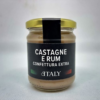
The Chestnut and Rum Jam, is a delicious compound with a gelatinous consistency with the fruit in question, the distillate, water and sugar.
Out of stock
The Chestnut and Rum Jam, is a delicious compound with a gelatinous consistency with the fruit in question, the distillate, water and sugar.
The chestnut is the fruit of the Chestnut tree, one of the largest trees in the forests of the Bel Paese along with oak and beech. Its origins are very ancient, much more than those of man, and also quite uncertain, it seems that it has always been widespread in most of the earth, from Europe to America passing through Asia Minor and northern Africa.
Even the first primitive men were already eating chestnuts, an important food and available to everyone. In fact the Greek Xenophon defined the chestnut as the tree of bread, and this was the case even in the following centuries, it was the bread of the poor present on every peasant table, at least until the arrival of potato and corn from America. They were a very nourishing food and therefore an excellent life saver in lean periods and famines.
Chestnut is also a very long-lived tree, the most famous and “old” one is Sicilian, it was right on the slopes of Etna, in the commune of Sant’Alfio.
According to some botanical experts it would be even 3-4000 years old, which would make it in all probability the oldest living being in Europe. It is about 25 meters high while the circumference of the trunk reaches 22 meters and that of the foliage is over 50 meters.
It is called the “Chestnut tree of the Hundred Horses”, because the legend says that, in the Middle Ages, a queen found refuge here from a storm with the hundred knights of her escort and their horses.
Rum is the brandy obtained by distilling the molasses produced by sugar cane.
Its origins are very ancient, some similar liqueurs derived from this plant were already appreciated and produced in China and in the Indies at the time of Marco Polo who tasted a variety in Persia.
Among the first ones in the seventeenth century to discover that molasses, obtained by sugar processing, could turn into alcohol by fermenting, there are the slaves working in sugar cane plantations in the Caribbean.
Jam is the name with which we identify all fruit based preserves, whereas the term marmalade, often used in our language as a synonym, is to be used only for citrus fruits based products.
The production of this sweet sauce is very ancient, it is already mentioned in the cookbook of the Roman writer Apicius, who told us that in the fourth and fifth century Greeks boiled quinces together with honey in order to obtain a sweet spreadable mixture.
A rudimentary jam was also appreciated by Romans who produced it by mixing fruit, grape must, raisin wine and honey.
For the use of sugar instead we must wait for the Middle Ages, which allowed to obtain a result more similar to the ones we can taste today.
It is in fact in this period that marmalade was invented and there are many legends about its origin. The birth of orange marmalade is attributed to queen Catherine of Aragon, who after her marriage with the king of England Henry VIII, feeling the lack of the fruits of her homeland, created this sweet compound in order to taste them in her new home as well.
Another legend instead attributes the creation and the name to the duchess Maria de Medici, who after her marriage and the following transfer to France with her husband Henry IV, began to suffer from a lack of vitamin C. In order to solve the problem, her doctor ordered a cure made of the best citrus fruits of Sicily, at that time however it was not easy to keep fruit for the time of such a long journey, therefore in order to solve the problem they prepared glass jars with citrus fruits and sugar, on which there was the writing “for sick Maria” which in French was misinterpreted as “marimalede”.
| Weight | 0,35 kg |
|---|---|
| Region of origin | Liguria |
| producer | Le bontà del Belvedere |
| Zona di produzione / lavorazione | ALTARE (SV) |
| packaging | 220g |
| Main ingredients | chestnuts 54%, sugar 44%, rum, lemon juice. |
| appearance | genuine and creamy |
| color | light brown. |
| smell | sylvan, intriguing with a strong but pleasant aroma note deriving from the presence of rum. |
| Taste | decisive and at the same time delicate. |
| conservation method | Fruit jams should be kept in a cool and dry place and should not be exposed to light. Once a jar has been opened, store it in the refrigerator and consume it within a few days. |
| designation | Tq.I.P. |
| Recommended pairings | health cookies, pecorino in oil,ugly but good , dry focaccia |
| Expiration date | |
| smaltimento | glass jar with aluminium cap; the metal/aluminium collection cap and the glass collection jar. |
Nutritional values
NUTRITIONAL VALUES PER 100 G:
ENERGY VALUE 966 kJ / 231 kcal
PROTEINS 1,76 g
FATS 1,14 g of which saturated fatty acids 0,2 g
CARBOHYDRATES 50,84 g of which sugars 34,95 g
SALT 0,004 g
FIBERS 5,13 g
The producer
Le Bontà del Belvedere is a micro company, located in Altare in the province of Savona.
The business is run by Mr Davide, who is not new to the gastronomic sector, in fact his family had been running a hotel restaurant in the village since 1967, which offered one of its specialities, farinata, one of the Ligurian dishes par excellence.
In 2005 Davide decided to convert the property into a workshop for the production of food products, equipped with all the modern machinery necessary for food handling and packaging.
The idea did not come about by chance, as well as wanting to continue the family tradition in some way by reinventing it, behind it there is also a strong love for his territory, that of Val Bormida, a river valley in the Savona hinterland, decidedly rich in noteworthy products, but which is usually only recognised as an industrial area.
This philosophy can be found in all the specialities of “Le Bontà del Belvedere”, which are produced as much as possible with local and almost zero-kilometre products, including the Rocchetta di Cengio pumpkin, which is recognised nationally as one of the best and to which a summer festival is dedicated. The same applies to fruit and vegetables, all of which come from the province of Savona or lower Piedmont, such as the IGP Nocciola Tonda Gentile.
Another product used in their recipes is the chestnut, queen of the local woods and originally a poor foodstuff typical of peasant tables, but now ennobled in more refined preparations.
In addition to the micro-business, since 2019 the family has been running one of the town’s historic ice-cream bars, Bar Franca, where it is possible to taste all their products, from breakfast to aperitifs, and discover new combinations.
The name “Le bontà del belvedere” is not accidental, but it is always a choice linked to tradition, in fact the old family hotel is called Belvedere.
Production area
Altare is a municipality of about 2000 inhabitants in the province of Savona, located inland but only a few kilometres from the sea. This small municipality is located in Val Bormida, famous for its history in the glassmaking activity, it is also remembered for the conventional demarcation point between the Alps and the Apennines, in fact at the end of the Viale dei Caroli there is the so-called Bocchetta di Altare.
Altare is a small village dating back to the Middle Ages, and as mentioned above, has always been famous for its glassmaking activity; this art was brought, according to some, by French families and according to others by Benedictine monks. Altare hosted master glassmakers from Orléans and Nerves, who showed them the tricks of the trade in glassmaking. Over the years, the families in the municipality created the Glass University, which today has important glass works dating from between 1750 and 1950. The village still has small workshops that continue the ancient tradition of glassblowing.
You may also like…


Related products