Italiano


€8,50
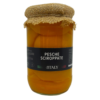
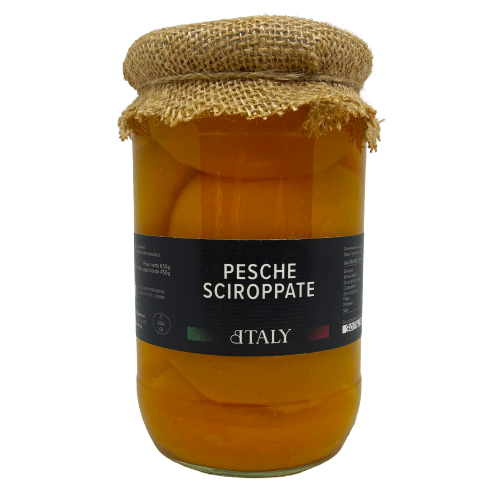
Peaches in syrup are one of the most classic summer preserves you can make at home. The syrup makes the peaches even tastier and more delicious.
Out of stock
The peach is a fruit with a history stretching back thousands of years. In recent years, scientists have found fossilized peach stones in Southwest Asia dating back to prehistoric times, long before the first humans appeared on earth.
The tree that produces this delicacy also originated in China, where it was considered more than just a tree and a symbol of immortality as far back as 8000 years ago. It is still a Chinese tradition for women about to be married to bring peach blossoms to the altar as a good omen for a happy and lasting marriage.
The peach arrived in the West thanks to the passage of the first caravans carrying goods from Asia to Persia and then from Persia to Europe.
In Egypt, this fruit was sacred; it was the symbol of the god of silence and childhood, Harpocrates. That is why even today children’s cheeks are compared to peaches.
Thanks to Alexander the Great, the fruit arrived in Rome in the first century A.D. and since then its cultivation has spread throughout the Mediterranean basin.
As far as cultivation is concerned, it is important that it is planted in a well-sunlit, moderately ventilated area. Planting should take place in early winter to give the roots time to prepare for the spring awakening. The rows in the cultivation should be arranged on a north-south axis.
There are different qualities of peaches, those with a reddish-yellow skin and those with a smoother skin. Thanks to the invention of canning, it has since been possible to eat them all year round in Europe, the most famous type of canning and preservation being putting them in a container with syrup, they became very popular during the two wars of the 20th century due to the scarcity of fresh fruit.
The peach is a tasty and refreshing fruit; it calms and relaxes the nervous system, so it also improves sleep. The peach kernel contains hydrocyanic acid, a powerful poison, and there are probably traces of it in the fruit, which explains its worm-like properties, so we must not ingest or open the kernels. The peach is a good revitaliser and tonic because of the many minerals and vitamins it contains. It is also useful for keeping our immune system in shape, protecting and improving our eyesight, giving elasticity to the skin and keeping it healthy, improving hair and nails and counteracting the damage of ageing. In short, its benefits are manifold and it should be a daily food, the important thing is that it is well ripe and not too much otherwise it can sometimes be poorly digestible.
| Weight | 0,7 kg |
|---|---|
| Region of origin | Piedmont |
| producer | Riolfi Sapori S.r.l. |
| Zona di produzione / lavorazione | Castelnuovo Calcea (AT) |
| packaging | 650 g |
| Main ingredients | Peaches 70%, water, sugar |
| appearance | Peaches cut in half and soaked in syrup |
| color | Orange |
| smell | Delicate and sweet |
| Taste | sweet |
| conservation method | Store in a cool, dry place, away from heat sources. After opening, store briefly in the refrigerator at +4°C. |
| designation | Tq.I.P. |
| Notes | Acidifier: citric acid, antioxidant, ascorbic acid |
| Expiration date | |
| smaltimento | glass jar with aluminium cap; the metal/aluminium collection cap and the glass collection jar. |
Nutritional values
NUTRITIONAL VALUES PER 100 G:
ENERGY VALUE 288 kJ / 68 kcal
PROTEINS 1,1 g
FATS 0,3 g of which saturated fatty acids 0,1 g
CARBOHYDRATES 14,3 g of which sugars 13,3 g
SALT 0,02 g
The producer
From a long family tradition, matured under the sign of love for the most natural and genuine products, RIOLFI sapori was born, an artisan company that, while respecting modern technologies, jealously guards what the earth can offer of precious and irreplaceable for our healthy diet.
The brothers Giorgio and Mauro Riolfi are craftsmen of quality, thanks to their passion matured in years of experience they choose and select the ideal raw materials to create their products: the quality of the fruit and vegetables they use is absolutely guaranteed by repeated and strict controls.
The aim of the company is to satisfy the desires of its customers, who want to taste those products that are not only the tradition of the company but also of the territory that hosts them.
Production area
Castelnuovo Calcea (also called Castelneuv Brusà which means burning castle in Piedmontese) is a very small Italian municipality of only 726 inhabitants in the province of Asti in Piedmont. It is situated on the hills between the Tiglione and Nizza streams, 23 km from Asti and about 9 km from Nizza Monferrato. It has become famous for being the birthplace of the poet Angelo Brofferio in 1802.
Some sources show that Castelnuovo Calcea is a village with very ancient origins. The first inhabitants were the Liguri Statielli, followed by the Celts and the Gauls. The place name is of Roman origin and derives from the union between the name Castrum Novum and that ad calcarias, which is certainly due to the presence of the nearby Roman road that often required backfilling. After the Roman domination, first the Lombards and then the Franks settled here. According to tradition, the original nucleus of the village, which was located on the hill that now houses the cemetery, was burnt down by Frederick Barbarossa. It was later rebuilt in its present location and in the 14th century became a possession of the Guttuari family from Asti. Finally, in the 18th century it changed hands; the Savoys lost control and the village became part of the Duchy of Milan.
Related products