
 Italiano



€9,00
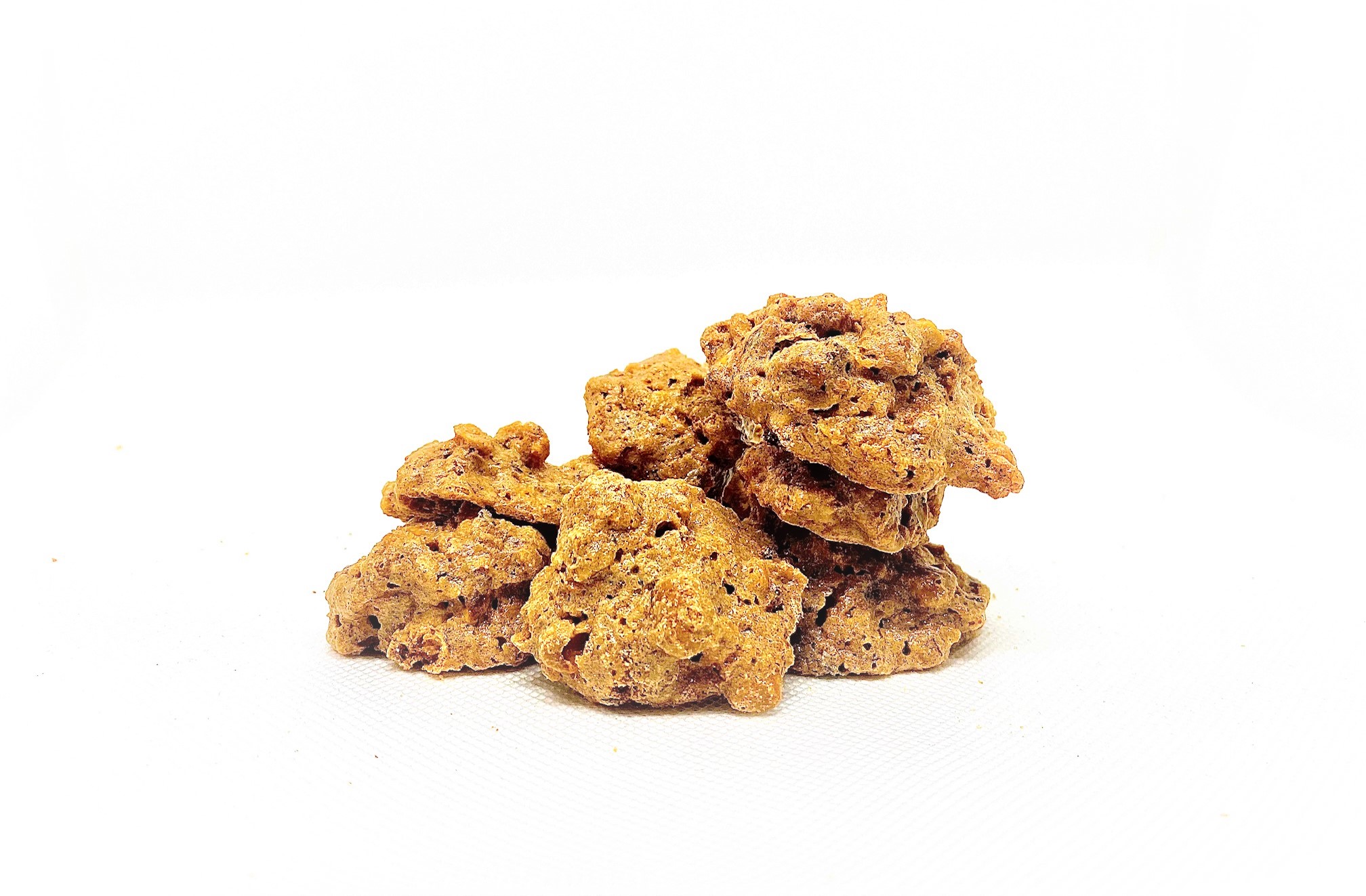
Ugly but Good cookies are dry biscuits made with round gentle hazelnuts from the Langhe PGI.
Out of stock
The Ugly but Good cookies, in Piedmontese dialect known as, “brut e bon”, as suggested by their name, are a misshapen, traditional cookie.
Appearances aside, they are undoubtedly a delicious sweet treat thanks to their simple ingredients, which include: hazelnuts, sugar and egg whites. These ingredients are used in specific amounts and in a delicate balance, which gives these sweets a crunchy consistency and a delightful flavor, all the while simple and genuine, like a midafternoon snack from your grandma’s kitchen.
Despite its distinctive Piedmontese name, the birth of this cookie, though undoubtedly of Italian origin, is contested between two regions: according to certain sources, they were created in 1878 in Costantino Veniani’s pastry shop in the Lombardy region in the town of Gaviarate in the province of Varese. Others say that they are original to the Piedmont town of Borgomanero in the province of Novara. Over the course of the following years these cookies spread throughout most of northern Italy.
Some variants include the addition of lemon zest or cinnamon, which is referenced in an old Milanese recipe.
Undoubtedly the most famous and traditional, the true Piedmontese “brut e bon” are those which use the round hazelnut of the Langhe region, IGP, an Italian excellence word renown. Ideal after a meal, they can be served with coffee or as a midafternoon snack. They can also be served with sweet wines such as Brachetto or Passito.
| Weight | 0,25 kg |
|---|---|
| Region of origin | Piedmont |
| producer | C. P. A. di Carrozzino Massimo |
| Zona di produzione / lavorazione | BISTAGNO (AL) |
| packaging | 200 g |
| Main ingredients | HAZELNUTS, sugar, EGG WHITE, CINNAMON, vanilla |
| appearance | irregular and homemade |
| color | golden ocher yellow |
| smell | biscuit and hazelnut |
| Taste | sweet vanilla and hazelnut |
| allergens | hazelnuts, egg, cinnamon |
| conservation method | keep in a cold and dry place |
| designation | contains round gentle hazelnut from Langa PGI |
| Recommended pairings | accompanied by a zabaglione cream, sweet Brachetto wines and passito |
| Expiration date | |
| smaltimento | Cardboard packaging and paper label; both in the paper collection. |
Nutritional values
NUTRITIONAL VALUES PER 100 G:
ENERGY VALUE 1728 kJ / 413 kcal
PROTEINS 11 g
FATS 20 g of which saturated fatty acids 8 g
CARBOHYDRATES 50 g of which sugars 27 g
SALT 0,1 g
The Producer
It started with a croissant…the story of a pastry chef of excellence
The story of Massimo and the pastry shop (more specifically the pastries) could be defined as a matter of love at first sight. It all started by chance, on a morning like all the rest: perhaps your alarm goes off, you have to go to school, and the only motivation you can find is in the croissant of your trusted pastry shop. This is how the story began, at Courmayeur, in Roberto’s shop. Massimo would stop by every day before school for a croissant. One day, the owner asked for a hand moving a big tray of freshly baked croissants. From that day forward, Massimo would find himself giving a hand in the shop during his free time or summer vacations. Without even realizing it, he began to learn the tricks of the trade and it soon became his passion and his career. During that summer of middle school, he not only learned the basics and the ins and outs of pastry that fascinated him so, but he also acquired something much more special as he gained a new father figure in the form of his mentor, Roberto.
Massimo had humble beginnings, starting from the bottom as an apprentice. Consequently, he maintained his training and later went on to study at the Etoile pastry school in Veneto and continues to frequent courses to this day in his quest to constantly better himself and his techniques.
He is ever aware of the importance of practice and experience and so finds the opportunity to work here and there, accumulating new knowledge in his suitcase. He has worked as a pastry chef in restaurants in big European cities, such as Paris. Through this experience he has had the occasion to make pastries for several heads of state (such as the Italian president, Cossiga and the French prime minister Mitterrand) and even made a delightful fruit tart for Pope John Paul II while on vacation in the Aosta Valley.
In 2016 he decided to stop and begin his own business, thus creating “Pasticceria da Massimo” in Bistagno, a town in the territory of Alessandria, where in his laboratory his inspiration allows him to create and experiment with new things, while always preserving tradition and the exigencies and tastes of his clients.
Some say pastry is an exact science, like Chemistry, but for Massimo it is not so. His only limits are precision and quality, and for the rest he is guided by passion, experience, intuition and a touch of genius and by natural and local ingredients, such as the round Cortemilia hazelnut that smells of tradition, genuineness, and home.
In 2020 his pastry shop became prized as an Italian Excellence and was mentioned in local and national newspapers as a stop in Bistagno not to be missed. His laboratory, especially during the holiday season, organizes short pastry courses for clients and friends who wish to learn something new by taking peek into the world of pastry.
Among the products that we offer, one can find great classics of the Italian pastry tradition: the “brutti e buoni” literally translated, “ugly but good”, a traditional, irregularly shaped Piedmont cookie; the “baci di dama” literally translated, “Dame’s kiss”, a treat for hazelnut lovers; and last but not least, the panettone, undisputed king of the Christmas table, with four gourmand varieties to try. What’s more, the panettone can also be used as a versatile base for many other desserts. The pastry chef advises to use the hollow version as an alternative base for tiramisu.
To conclude, a small piece of advice which describes how passionate this pastry chef is for his job. If you stop by the pastry shop for a tray of pastries, please, treat them nicely and do not squish them!
P.S. He was an amateur weightlifter, so be careful and take his advice!
Production area
The pastry shop from Massimo, is located in Bistagno (AL) small Piedmontese town located in the Alessandria area.
The town was founded in medieval times as a fortified bulwark on the road that connects the town of Savona to Acqui Terme. Bistagno, starting from the historical center that still today presents the ancient triangular plan, develops following the banks of the Bormida.
The typical products of the river valley in the hinterland of the town, where there are several farms, are hazelnuts, goat cheese and wine.
Related products


