Italiano

€18,00
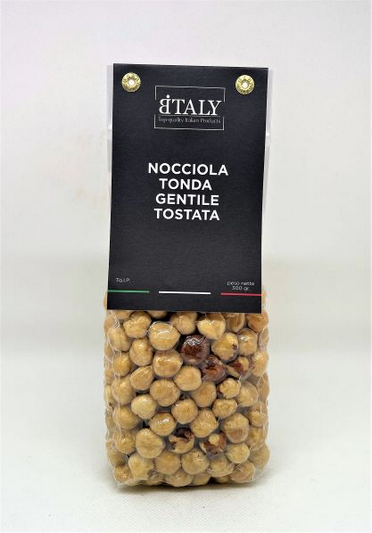
Piedmontese hazelnut IGP
Out of stock
The hazel tree represented for the first nomad tribes an essential source of energy.
It was one of the first fruit-bearing trees cultivated by humans. At the beginning of the 19th Century, Emperor Napoleon Bonaparte blocked exportations from England, and the cacao being among these exportations became very difficult to find and an expensive product.
For this reason, bakers from the city of Turin had to find an alternative to continue making their products so they decided to mix the cacao left with a type of hazelnut called ‘Nocciola Tonda Gentile Trilobata’, creating like this a new tasty product namely ‘Gianduja’.
In the middle of the two World Wars, the cultivation of the hazelnut spread across the ‘Langhe’ area, and thanks to professor Emanuele Ferraris who showed a passion for these nuts, it is known that the hazel tree is the hardiest and most lasting of all grapevines.
Characteristics
Characteristics of Piedmont Hazelnut PGI (Protected Geographical Indication) rank it among the most appreciated high-quality products in the world. Its main features include:
- A great quantity of the fruit is found when shelled
- Excellent flavour and aroma after toasting
- Easy shelling
- Fine and lasting taste
- It is low in fat so it can be kept well for long
Furthermore, amino acids essential to the human body, as well as vitamin E, are found in the nut. Besides, the percentage of lipids in a nut is 40%, including unsaturated fat such as oleic acid, and it has the highest monounsaturated/polyunsaturated ratio compared to other nuts. Recent studies show positive effects on human health in the regular consumption of nuts. Indeed, adding oleic acid to a diet keeps cholesterol in low blood levels.
As previously introduced, ‘Nocciola Tonda Gentile delle Langhe’ or ‘Nocciola Trilobata Piemonte’ is a type of hazelnut found in the area of low Piedmont, specifically, in the province of Cuneo, but it can also be found in the province of Asti and Alessandria, in those places between the hills of the Langhe, Roero and Monferrato.
What immediately catches the eye when you pick up a Tonda Gentile del Piemonte Hazelnut is its very thin but hard shell, which protects a large, spherical and regular fruit wrapped in an external film (the perisperm) which is also very thin and easy to remove. Its main characteristic is the fact that it has lower fat content than other hazelnut families and this makes the rancidity processes slower making it perfect for the preservation and transforming it into a food that, if eaten regularly, helps to keep ‘bad cholesterol’ at low levels in the blood and to raise ‘good cholesterol’ instead, favouring the protection of cell membranes.
Vitamin E contained within it is also significant and is a natural antioxidant that slows down tissue ageing. Tasting it immediately brings you to appreciate its fabulous and famous aroma after roasting.
Piedmont hazelnut is known as the best in the world. The Tonda Gentile Hazelnut carries the PGI denomination, which guarantees and certifies not only its quality but also its absolute authenticity.
| Weight | 0,3 kg |
|---|---|
| Region of origin | Piedmont |
| producer | AZIENDA AGRICOLA BIOLOGICA LA GHIANDAIA |
| Zona di produzione / lavorazione | BONVICINO (CN) |
| packaging | 300 gr. |
| Main ingredients | NOCCIOLA TONDA GENTILE |
| appearance | slightly toasted, roundish |
| color | light brown |
| smell | intense aroma of hazelnut |
| Taste | intense flavor of toasted hazelnut |
| allergens | PIEDMONT HAZELNUT I.G.P. |
| conservation method | keep in a cold and dry place |
| designation | IGP |
| Recommended pairings | THIS HAZELNUT FINDS ITS GREATEST EXPRESSION IN THE CONFECTIONERY INDUSTRY AS IT COMBINES PERFECTLY WITH CHOCOLATE AND ESPECIALLY WITH GIANDUJA. |
| Expiration date | 30/05/2023 |
| smaltimento | Plastic packaging and paper label; packaging in the plastic collection and label in the paper collection. |
Nutritional values
NUTRITIONAL VALUES PER 100 G:
ENERGY VALUE 2818 kJ / 683 kcal
PROTEINS 14 g
FATS 65 g of which saturated fatty acids 5,9 g
CARBOHYDRATES 6,5 g
SALT 0,02 g
The producer
Innovation, sustainability and the best of organic products… meet the tradition of the past!
Francesco’s story is closely connected to his land, the splendid Alta Langa Cuneese. We are in the tiny hamlet of Lovera, which has fourteen inhabitants (soon to be fifteen, work in progress, it seems that a stork has flown over the Langhe…), while there are less than a hundred inhabitants in the entire municipality of Bonvicino.
The tradition of the farm has ancient roots, Francesco’s grandfather already cultivated and lived off the fruits coming from that land. It was the classic farmstead dedicated to agriculture, the traditional one with cereal fields, vegetable gardens and orchards, as in all the rural areas of the Piedmontese countryside. In 1992, the family decided to transform the business into an organic farming, an activity that was certainly more intriguing and profitable, but also more difficult. A challenge that suited the area in which the property is located, the soils are perfect, indigenous and of varying composition and their soil is excellent for this type of cultivation. Fortunately, thanks to the family’s long agricultural tradition, the land has been worked for centuries to bear fruit, always with passion and dedication to preserve and improve its natural fertility.
At La Ghiandaia, we always care for the conservation of the land and its preservation, in fact, there are many ancient native varieties of cereals that are rediscovered and cultivated here with the aim of bringing the genuine and authentic flavours of the past, back into the homes of today’s and tomorrow’s families. Among these products, for example, we find ‘Ottofile maize flour’, a variety of grain excellent for ‘polenta’ which has almost disappeared due to the mass farming and large-scale production of American origin.
The property is a traditional courtyard-style stone farmstead, set in a beautiful valley, framed by green fields and vast expanses of hazelnut groves, but not just any hazelnuts: this is the famous ‘Nocciola Tonda Gentile d’Alta Langa PGI’, the queen of the Langhe, quoted on the Stock Market equally to a precious metal. In addition to the direct cultivation of the products on-site, which allows an extremely controlled, guaranteed and 0-km production chain, the company is equipped with milling machines for crushing grain into flour, like those of the past, with stone and wooden structures. This gives the small industrial workshop a rustic and elegant look. Inside, everything is perfectly tidy, clean and as white as the flour, almost like a fairy-tale. This painstaking attention to detail in production guarantees an authentic flavour and look to the products. The ancient technique of stone milling is the only one that preserves the best properties of the wheat.
With all this ‘tradition talk’, one might imagine a scenario devoid of innovation. However, La Ghiandaia still amazes us from this point of view as well. An important aspect that Francesco focuses on is respect for the territory, not only for preserving the varieties of local products but also the environment. At La Ghiandaia Organic Farm, everything is eco-sustainable, thanks to a modern and advanced photovoltaic system that uses every ray of sunlight that kisses this beautiful valley every day. Everything is powered by this completely green energy, ensuring that all the farm’s processes have zero CO2 emissions. Passion, dedication and love for one’s land and for nature always pay off!
Production area
‘Bonvicino’ is a small town located in the province of Cuneo with less than a hundred inhabitants.
The centre is made up of a few small houses grouped around the parochial church of Saint James and Saint Christopher, while in the even smaller district of Lovera there are some farmsteads for agricultural production.
The name of the village has very ancient origins. It seems to derive from the Latin appellative of ‘Bonus Vicinus’, given by the neighbouring town Belvedere at the time of the great plague epidemic in 1630, as a sign of gratitude for the help received in times of need.
In the territory, the agricultural activity is widely practised as there are many fields for cultivation of grain, cereal, the ‘Tonda Gentile di Langa’ hazelnut PGI (Protected Geographical Indication) and vines located near the Dogliani area.
Related products