
 Italiano

Btaly On Tour, what to eat in...
4- ANDRIA – BTALY on TOUR: Andria’s traditional dishes.

Jun
Btaly On Tour : Andrian Cuisine
Andrian cuisine is a variant of Apulian cuisine, which is widespread not only in Andria but also throughout the Apulian region.
Btaly On tour wants to give the opportunity to introduce people visiting this extraordinary province to the recipes and typical dishes that have been handed down from generation to generation.
HERE’S WHAT TO EAT IN ANDRIA AND PROVINCE!
- The sfricone:
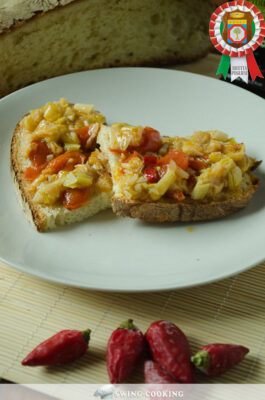
Source of the photo: swingcooking
In the minds of many people in Andria, memories of grandparents in the countryside with boxes of freshly harvested cherry tomatoes that gave off a special scent resurface; these cherry tomatoes were tied and hung in the cellar where wine was also usually made. This ancient procedure made the cherry tomatoes a drop drier but still tastier. Today, unfortunately this preservation procedure is no longer used because in supermarkets we can find them in every season. Thanks to the amount of cherry tomatoes in the cellars of the inhabitants of this region, this recipe was born, which historically required that “hanging” cherry tomatoes be used.
This recipe is called “lo sfricone” in dialect; over the years they have become a classic of Apulian cuisine. The cherry tomatoes are combined with “sponsali” also typical of Puglia, which is a vegetable very similar to onions but with a sweeter and more delicate flavor.
Sfricone was made on cold winter evenings and served with slices of good bread, when a dinner simply consisted of poor but no less tasty foods such as bread, onions, caciocavallo cheese and olives.
The sfricone: an Apulian tradition!
| Cooking time: 25 min | Cost: Low |
| Total time: 25 min | Portions: 4 servings |
Ingredients:
- 1 kg of sponsals
- 10 hanging cherry or cherry tomatoes
- salt
- chili pepper
- extra virgin olive oil
- slices of Altamura bread or other Apulian bread
PREPARATION:
The first step for this recipe is to clean the sponsali, you need to cut off the head part and then you flake them, starting from the bottom, just remove 2 or 3 leaves that wrap them, then you wash them and cut them into rounds stopping, when the sponsali part becomes too green.
They are soaked in boiling salted water for 5 minutes, so as to remove the vegetation water and make them more digestible, drained and put in a pan with the squeezed cherry tomatoes, oil and chili pepper, depending on personal taste.
Finally, cook for about 20 minutes or until tender, salt and serve with slices of good Pugliese bread such as the very famous Altamura bread.
Enjoy!
2. U cutturidd

Source of the photo: nellacucinadiangela
Easter lunch for the people of Puglia is a unique time as everyone gathers with loved ones around the table for a long feast of multiple courses that usually lasts for hours.
The second typical dish of this gastronomic marathon, especially in the Apulian Murgia, is lamb cooked for hours in a special earthenware pot with lampascioni and other spiced vegetables.
The dish has different names depending on some variations related to the traditional recipe: it is called Cutturidd, Agnello alla Rizzola, Callaridd, etc.
Cutturidd is an ancient method of cooking meat with seasonal country vegetables, cooked very slowly over the high flame of the fireplace: it takes only 3 hours to turn lamb that would otherwise be cooked in 2 hours using any home oven that has better ventilation and the temperature is about 120/ 130 ℃.
The ingredients needed for “U cutturidd” are: of course lamb meat, wild fennel, lampascioni, potatoes, garlic, onion, cardoncelli mushrooms, carrots and also leftover some kinds of cold cuts or cheese are used.
U Cutturidd: the second DOC of Easter lunches!
| Cooking time: 120 min | Cost: medium |
| Total time: 245 min | Portions: 4 servings |
Ingredients
- 1 Kg of sheep meat
- 1 onion
- 500 g of potatoes
- 400 g of ripe tomatoes
- extra virgin olive oil
- 1 carrot
- 1 celery stalk
- 200 g of wild chicory
- 100 g of lampascioni
- 4 bay leaves
- 1 glass of wine vinegar
- 80 g of grated pecorino cheese
- pepper
- salt
PREPARATION:
The first step is to take the sheep meat and cut it into small pieces.
Put it in a bowl, after which soak it with water, vinegar and bay leaves. Let it sit for at least two hours.
Meanwhile, cut the peeled potatoes into small chunks. Carefully clean the wild chicories, being careful to remove the soil and roots. Do the same for the lampascioni, which should be left whole.
Next, chop the carrot, celery and onion.
At this point, take the typical pignatta and put in it the necessary amount of oil to sauté the onions, carrots and celery. Then add the previously washed and chopped tomatoes.
Cook for 5 minutes, then put in the potatoes, chicory, and lampascioni with plenty of water. Also add a good handful of salt. Bring everything to a simmer.
Finally, drain the bowl with the sheep meat, discarding the liquid. Then add the sheep pieces and bay leaf to the cooking liquid in the crock pot. Add additional water to the cooking and let it simmer for about 2 hours.
Serve the dish piping hot.
Enjoy!
3. Bisceglie colva:

Source of the photo: lacuocaignorante
Most citizens of Bisceglie are aware of the ancient Christian tradition behind this “magic” dish, which is still served in November, the month in which the feast of the dead is present. In other words, each grain of wheat eaten symbolizes a prayer for the salvation of the souls of one’s dead.
The origins of this cake, in fact, are much older, and certainly of pagan origin. In fact, its name is easily reminiscent of the Greek word Kòlluba (colliva), a dish that is never missing from festivals honoring the dead.
Greek legends also tell that the dish was offered to Dionysus and Hermes as a sacrificial rite.
Bisceglie colva is composed of four ingredients and each of them holds a different meaning: the wheat kernels that once sprouted underground represent rebirth; vincotto recalls the wine poured by the Etruscans over the graves of their loved ones; and last but not least, pomegranate is the symbol of life.
The Bisceglie colva: a dessert to honor the dead!
| Cooking time: 150 min | Cost: Low |
| Total time: 160 min | Portions: 10 Servings |
Ingredienti
- 500 g of wheat
- 300 g of toasted almonds
- vincotto / chocolate
- 2 pomegranates
PREPARATION:
The first step is to sift the grain, trying to remove all impurities present after which you rinse it and let it soak for at least one full night.
The next morning, drain the water and run it under the tap.
At this point pour it into a pot; cover it with water and cook it over low heat.
Cooking times generally vary from two to three hours (depending on the type of wheat being used).
If you see that the water has evaporated before the required time, add more water.
Once cooked, drain and allow it to cool. At this point toast the almonds for a few minutes in the preheated oven, crumbling them coarsely.
In the meantime you can start cleaning the pomegranate.
Take bowls or wherever you like best to serve the colva and add the grain, toasted almonds, pomegranate kernels and finally add the vin cotto.
There are also varainti to the classic recipe: the best known and most popular involves replacing the vincotto with chocolate.
4. Andria burrata:

Source of the photo: casabufala
Burrata di Andria IGP is one of those Italian products that is most appreciated both within the peninsula and abroad. We are envied by the whole world, and it is delicious both to eat on its own au naturel and to create fabulous combinations.
It makes you want to eat it just by seeing it. Once cut on your plate, you’ll want it to never end, especially when it drops the milk and releases all its fragrance.
It is not easy to trace the origins of this wonderful product, but the idea seems to have come from Lorenzo Bianchino, a cheesemaker who operated in the Altamurgia National Park in the early 20th century. It seems that one day, stranded on the farm due to a blizzard, he was supposed to bring milk to the valley, but unable to fulfill his mission, Lorenzo Bianchino gave birth to what we now call burrata.
Many Italians, but especially foreigners, often confuse burrata with classic mozzarella. Burrata, however, is a completely different product and made in a completely different way. While mozzarella is made from curd, which is obtained by combining pasteurized cow’s milk with milk enzymes and rennet, it too is always prepared starting with the spun paste of mozzarella, which, however, is used only as a casing to hold the stracciatella, the creamy filling of burrata. And it is precisely by cutting it that one can immediately recognize the difference; but the taste is also different, with its creamy flavor, delicate but firm and savory at the same time.
5. Lamb tiella:

Source of the photo: sud italia in cucina
Tiedd d’Aggnidd e Patan or Furn, there is nothing more Easter-like than this recipe. In Italian, its name is Tiella or baked lamb pan with potatoes.
However, how do you get everything baked to perfection without one of them drying out or still being raw (the lamb or the potatoes)? There are some little tricks we can use.
First of all, you need an aluminum or earthenware pan, because if you use these materials there is a better chance that the lamb will remain soft and that the heat will be transferred optimally.
Another thing that absolutely must be taken into consideration is the size of the lamb pieces, which should be neither too small nor too large because we must not forget that lamb is red meat and therefore cannot be cooked if it is too thick. The inside must remain pink. You then need plenty of excellent extra virgin olive oil, you could also use butter but we would no longer be in Puglia or Lucania.
Lamb tiella: the perfect match for potatoes!
| Cooking time: 150 min | Cost: medium |
| Total time: 180 min | Portions: 4 servings |
Ingredienti
- 1,5 kgof small suckling lamb
- 1,5 kg of excellent quality potatoes
- a bunch of fresh parsley
- a few branches of rosemary, possibly fresh
- two or three cloves of garlic
- six to eight tablespoons of extra virgin olive oil
- salt and black pepper
PREPARATION:
The first step for this recipe is to prepare a marinade with 4 tablespoons of oil, parsley, garlic, salt and pepper.
After that, rinse the meat and let it drain. We clean the potatoes, cut them into rather large cubes and put them in water so that they do not blacken.
We generously and carefully grease a baking dish, preferably aluminum and arrange so that all spaces are well filled, the pieces of meat, mashed and repassed one by one by abundantly greased hands, on top we will arrange the potatoes, seasoned in a salad bowl with the remaining marinade, turning them well.
Finally, we will add the garlic and a little rosemary. Next we bake the whole thing at 200°C possibly in the lower part of the oven.
It should stay in the oven for at least an hour being careful not to open it so that the heat remains inside. When the potatoes have reached the right coloring we can turn the potatoes and meat so that the meat is on the surface.
At this point we wait for half an hour so that the meat is also browned, in this time the moisture produced by the meat and potatoes will also disappear, in the second stage we place in the center of the oven. Serve while still hot.
Enjoy!
6. Donkey Ragout:

Source of the photo: sud italia in cucina
The donkey ragout is a typical specialty of the province of Andria, passing in front of butchers in the area you can find signs displaying the price per kilo of donkey meat, excellent for making a ragout. Apulia we must not forget that it is the land of origin of the greatest Donkeys on Earth: such as the donkey of Martina Franca. Strangely enough in Taranto, in whose province Martina Franca is, it is not common to find this meat, very common instead in the Bari area and in the province of Barletta-Trani-Andria.
The meat is very lean and rather dark, characteristics common to horse meat. Usually braised, stewed and overcooked dishes were suggested with this meat; it is evidently a rather tough meat, suitable for long and spicy cooking.
Ragout of donkey: the ragout from Puglia!
| Cooking time: 180 min | Cost: medium |
| Total time: 420 min | Portions: 4 servings |
Ingredients
- 0,5 kg of donkey meat
- 2 glasses of red wine from Troia
- 2 cloves of red garlic
- 1 red onion
- 2 parsley leaves
- 1 chili pepper
- 50 g of salted lard
- 1 bottle and a half of tomato sauce
- 6 tablespoons of extra virgin olive oil
- pecorino canestraio pugliese
PREPARATION:
The first step for this recipe is to macerate the donkey meat for about four hours. Prepare a coarse mince of garlic, onion and parsley, with it we sprinkled the meat, add the black wine of troy and a broken dry chili pepper.
After about four hours, we extracted the meat, strained the wine and the vegetables, drained, and gently sautéed them in EVO oil and chopped lard, which we need to slowly melt. It is important to add the lard because donkey meat is very lean.
When the chopped vegetables have totally wilted you have to set them aside. At this point you sauté everything over high heat for a few seconds, then fill the pot with wine and leave it on low heat for a few hours until all the wine is absorbed.
When the meat has returned to seasoning, that is, when all you will see in the bowl is meat and oil, add the tomato sauce with basil leaves and the proper salt. Also add the chili pepper that was used in the marinade. It should be brought to a boil, raising the heat, then lowering it again.
At this stage the lid should be placed on the pan in such a way that it does not close it tightly, or if this is not possible, the lid should be placed on the wooden ladle, this is to allow very slow evaporation of excess water.
The slow cooking will take no less than two or three hours, for a total then, excluding marinating, of about six hours of processing and cooking.
Enjoy!