
 Italiano

Btaly On Tour, what to eat in...
2- ALESSANDRIA – BTALY on TOUR: traditional Alessandria dishes.

May
Btaly On Tour : The Alessandrian cuisine
A mix, if one can say so, between Ligurian and Piedmontese traditions, with some Provençal influences, characterize the traditional cuisine of Alessandria, honoring the uniqueness of a place that enjoys a unique geographical location.
Typical flavors of Piedmontese culture meet with other gastronomic traditions and, amid history and legends, merge into new flavors that tell the story of the area and its community.
Btaly On tour wants to give the opportunity to introduce people visiting this extraordinary province to the recipes and typical dishes that have been handed down from generation to generation.
HERE’S WHAT TO EAT IN ALESSANDRIA AND PROVINCE!
1- THE GREEN MONFERRINA AGLIATA:

Source of the photo: piemontetopnews
Agliata verde monferrina is a typical appetizer of the Piedmontese tradition, specifically we can place it in the hills of Monferrato. There are several recipes of this typical dish, the main one involves the use of parsley, basil, celery cheese and of course garlic.
The origin of the recipe is very ancient! There are sources that even date back to medieval times.
It is a very poor dish in fact it was mainly consumed by peasants as a condiment or preservative for food also due to the simplicity and low cost of the ingredients.
Today it is mostly used as an aperitif. The cream can be served on the table, spread on crispy croutons, or collected in small bowls and enjoyed with breadsticks. But it is also a great condiment for pasta or an original addition to accompany freshwater fish.
The authentic recipe called for garlic pounded in a mortar, with other herbs added from time to time.
The original recipe has been reworked over the years and cheese has been added, making it heavier but definitely more appetizing. The cheese used was toma or robiola, two fresh cheeses from Piedmont. Toma is a cheese (found in the Alessandria area but also common throughout Piedmont) that is mild and becomes tangy with aging. Robiola is commercially available, and it is slightly fattier and more flavorful than toma. When making agliata del Monferrato, using either cheese is a matter of personal taste.
Agliata verde Monferrina: a sauce with a historic flavor!
| Cooking time: None | Cost: Low |
| Total time: 15 min | Portions: 6 Servings |
Ingredients:
- 200grams of Robiola or Toma delle Langhe, still fresh and soft
- 25 grams of parsley (leaves and stems)
- 10 celery heart leaves
- 5 basil leaves
- half a lemon
- 2 cloves of garlic
- salt and pepper
- extra virgin olive oil
PREPARATION:
The first step in making this dish is to clean the parsley and celery, then you need to place them in the mortar along with the basil.
Next, add garlic to the mortar and pound all the mix until the consistency is smooth.
At this point, you can put the various seasonings: salt, pepper, a tablespoon of lemon juice and a drizzle of strictly extra virgin olive oil!
The last step to complete the recipe is adding the cheese to the bowl with the vegetable mixture previously made in the mortar, you need to stir vigorously with a spoon until all the ingredients are well mixed. The mixture will be ready when it looks like a shimmering green cream.
2. BAGNA CAUDA:

Source of the photo: cibovagare
Oil, garlic and anchovies: these are the basic ingredients of bagna cauda (also known as “bagna caoda”), one of the symbols of Piedmontese cuisine.
This sauce, in fact, is the ideal condiment for vegetables, so much so that it is spoken of, not surprisingly, as a hot variant of the typical pinzimonio of the spring and summer seasons. Its history is rooted in the medieval period and deserves to be deepened and known, also because we are not talking about a simple sauce, but a real ritual. The Middle Ages is the time when this condiment was first introduced.
It was a custom of Piedmontese peasants who needed to shelter themselves from the winter cold: the main testimonies locate the birth of bagna cauda in the areas of Alessandria, Asti, Monferrato and the Langhe, precisely in the places where vineyard owners used to celebrate the new wines with vegetables and this hot sauce, a real poor man’s dish.
On the contrary, the more noble classes did not particularly like the recipe because of the excessive presence of garlic. Many centuries have passed since those years, but it is still customary to consume the condiment sitting around the table, with an earthenware container keeping the temperature high.
At this point doubt might arise.
How is it possible that one of Piedmont’s main recipes is based on anchovies, given that the region is landlocked?
The explanation is simple.
In the Middle Ages, there were obviously no fishermen in the northern region, but anchovy makers were, since salt was expensive, and from the mountains people traveled the roads to Liguria to buy it at lower prices. The salt was then hidden inside barrels and covered by the anchovies.
The fish was then resold at very competitive rates: contact with the salt made them tastier, as well as prolonging their shelf life.
Bagna Cauda: from the anchovy makers to the table!
| Cooking time: 45 min | Cost: Medium |
| Total time: 3 h 30 min | Portions: 4 Servings |
Ingredients:
- 4 garlic heads
- 100 g of salted anchovies
- a glass of red wine
- 150 g of extra virgin olive oil
- seasonal vegetables to taste
PREPARATION:
To make this famous typical Piedmontese dish, first you need to peel the garlic heads, removing each clove from its jacket and stripping them of their sprouts.
After you have finished cleaning the garlic you can start to deal with desalting the anchovies. To do this procedure it is necessary to put the anchovies in a bowl, cover them with cold water and let them soak there for at least two hours, trying to change the water at least twice to remove the salt. This operation is very important and delicate because if it is done incorrectly the anchovies risk flaking. When the anchovies have softened,they need to be drained.
Next, open the anchovies to clean them so as to extract the innards and the central bone.
As soon as you finish the previous step, you can start lining a tray or baking sheet with paper towels and then arrange the open fillets on it.
Transfer the anchovies to the tray and dry them with paper towels. Place the garlic in a saucepan, pour in 100 grams of olive oil and start cooking over very low heat, stirring with a wooden spoon, being careful not to let it discolor.
Add the anchovies and stir gently.
Cover with the remaining oil and simmer the sauce for half an hour, being careful not to let it sizzle. In the meantime, prepare the vegetables to go with the bagna caoda, taking care when cooking them: brown the onions with their skins on in the oven, then cut them into wedges.
The potatoes are cooked in boiling water; they should not get too soft so that they can be cut into wedges. Finally roast the beet and cut it like any other vegetable. Roast the peppers in the oven and cut them up and make wedges out of them.
Now go ahead and prepare the raw vegetables: wash the cardoons, remove the ends and outer filaments and cut them in half lengthwise. Traditionally the shallots are washed and soaked in wine, preferably barbera. Once the anchovies are dissolved, the bagna caoda is ready to serve at the table preferably in a typical “fojòt.”
3. THE ZUCCHINIS CARPIONATA :
Source of the photo: buonissimo
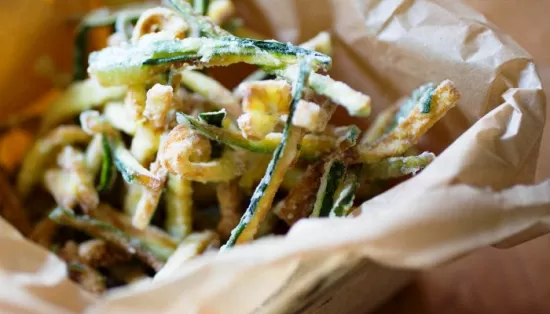
Zucchinis carpionata is a famous and delicious traditional Piedmontese appetizer found mainly in the province of Alessandria; it is prepared with fried zucchinis that are then flavored with a mixture of wine, vinegar, herbs and onions.
Usually, the preparation called “in carpione” is used for lake fish such as trout or for salmon; but it is also perfect to be combined with certain cuts of meat or with certain vegetables. For this reason, zucchini in carpione was tried in Piedmont, and they have since found that the combination worked. The carpione also allows this dish to be prepared a few days in advance (keeping it in the refrigerator) without spoiling the product. Zucchini carpione keeps several days in the refrigerator so you can prepare it in advance and then serve it at your leisure.
Zucchini carpionata: the all-piedmontese carpione!
| Cooking time: 10 min | Cost: Low |
| Total time: 30 min | Porzioni: 6 Porzioni |
Ingredients:
- Zucchinis 1 kg
- Garlic 4 cloves
- Vinegar 1 tablespoon
- Sage 5 leaves
- Mint 5 leaves
- Extra virgin olive oil 2 tablespoons
TO FRY:
- Extra virgin olive oil 2 tablespoons
- Salt
FOR THE BATTER:
- Flour 00 150 g
- Sparkling water 100 ml
- Salt 1-2 pinches
- Instant yeast 1 teaspoon tip
PREPARATION:
Wash the zucchinis, cut them into strips and lay them on a clean tea towel to dry. Dust the zucchini with flour and fry them, then lay them on blotting paper to remove excess oil.
Now prepare the carpione. Pour the olive oil into a saucepan and add a pinch of salt, sage, mint leaves and crushed garlic cloves.
Then bring to a boil over medium heat and sauté the garlic lightly until it reaches a classic golden color, add the vinegar and let it evaporate. Place the hot carpione on top of the zucchini and let it rest.
Serve cold in a basket covered with baking paper.
4. AGNOLOT D’ALESSANDRIA:

Source of the photo: mole24
Piedmontese agnolotti, or more simply agnolotti (agnolòt or gnolòt in Piedmontese dialect), is a traditional stuffed pasta specialty of the Astesana and especially Monferrato area in the provinces of Alessandria and Asti, but widespread throughout Piedmont.
There are no precise sources on the origin of the name agnolotti, one of the most famous popular traditions states that its name comes from a cook from the Monferrato area (a historical-geographical region included mainly within the provinces of Alessandria and Asti) named Angiolino who was called Angelot. Over the years, therefore, this dish has been named after the cook who invented it and later turned into agnolotti. Moreover, in addition to the oldest source there is another theory that derives the name of this first Piedmontese dish from the “anolot,” which was a tool used to cut pasta into a ring shape.
According to tradition, the shape should be square with the filling enclosed in two sheets of egg pasta. Unlike other stuffed pastas characteristic of other parts of Piedmont and the province of Alessandria or other regions, agnolotti are characterized by the presence of roasted meat in the filling.
One type of agnolotti especially typical of the Langhe are those commonly called al plin which are small in size and have a rectangular shape. The word “plin” comes from the Piedmontese dialect and means pinch because precisely you have to pinch them closed. In the province of Asti, adjacent to the province of Alessandria, and more specifically in the town of Calliano they are made with donkey meat.
Both classic agnolotti and the smaller al plin have been included in the list of Italy’s traditional food products (PAT), the list is compiled by the Ministry of Food and Forestry Policies. They can be served in a variety of ways, the most traditional recipes call for seasoning with:
- meat broth,
- butter, sage and Parmesan cheese,
- the Piedmontese meat sauce,
- the roast meat sauce,
- in wine (only in some areas of Alto Monferrato and Langhe).
Classic recipes do not call for a Piedmontese lean filling: in rare cases they are called ravioli themselves; Piedmontese tortellini made with a fontina cheese filling are also called ravioli.
Agnolotto is a classic of Piedmontese popular cuisine: in fact, it is customary to use leftovers from the previous days’ roasts, chopped and mixed together.
Given this origin, it would be inappropriate to speak of a typical recipe for the filling, because according to tradition the leftovers on hand had to be used, in fact this is considered the most authentic origin of agnolotto.
In fact, this recipe involves not only the reuse of leftover meat, but also the roast sauce, to respect the peasant tradition of avoiding all waste.
Piedmontese Agnolotto: when the roast meat leftovers…
| Cooking time: 4 min | Cost: Medium |
| Total time: 1 h 30 min | Portions: 6 Servings |
Ingredients:
For The Stuffing:
- 500 Gr. Beef Stew
- 1 Escarole Salad
- 150 Gr. Parmesan cheese
- Some Sweetbreads
- 150 Gr. Sausage
- 150 Gr. Cooked Salami
- 5 Eggs
- 500 Gr. Flour
For the Pastry:
- 3 Eggs
- 3 egg yolks
- 500 Gr. Flour
- Salt
PREPARATION:
The first step in making this Piedmontese classic is to clean and shred the escarole, next you need to combine the stewed beef, sausage, cooked salami and sweetbreads (previously blanched) already shredded.
Next, mix everything together and make a thin sheet of dough so as to cut out strips of dough about ten centimeters wide and place the filling 1 cm apart.
Finally, cover with another strip, adhere the dough and separate the agnolotti with the classic pasta wheel.
Serve with meat sauce (which we suggest our Btaly branded ragouts with wild boar, deer or hare) or with butter and sage.
5. POULET A LA MARENGO:
Source of the photo: Instagram chisako_felicioo
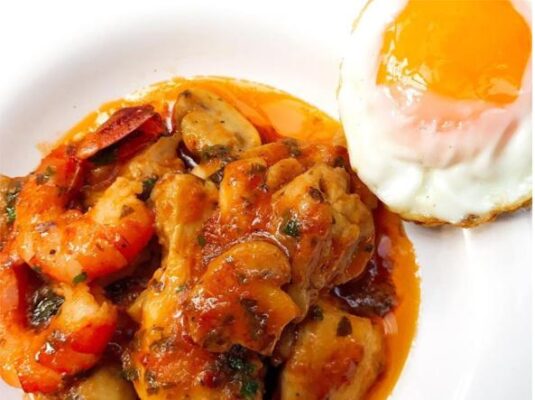
Chicken alla marengo is a very tasty second course of the typical cuisine of the province of Alexandria, rich and simple, it tantalizes the taste buds with a variety of combinations and flavors: from chicken to shrimps, eggs, and ending with the subtle aromas of white wine.
Besides being a very tasty recipe, this dish has a historical origin and a legend linked to the great leader Napoleon Bonaparte.
In fact, Marengo is the name of the town south of Turin where Napoleon defeated the Austrians in the famous battle of the same name on June 14, 1800.
Legend has it that after the battle Napoleon, who was not accustomed to eating beforehand, asked his personal cook Dunand to prepare dinner for him, however, being in the midst of a battle he found himself unprepared and undersupplied with ingredients. So Dunand tried as quickly as possible to find ingredients to satisfy his boss.
He managed to find a chicken, eggs, tomatoes, and crayfish. With these few ingredients he was able to combine them in an ingenious way and create this second dish that Napoleon liked so much that he ordered his chef to prepare it for him at the end of every battle, both because he liked it so much and also a bit for superstition.
6. BRAISED BEEF WITH BAROLO:

Source of the photo: langhe.net
The braised beef in Barolo is a rich and tasty dish typical of Piedmontese cuisine (Alessandria and Langhe area). It is prepared with a piece of braised beef, that is, first browned, then slow-cooked with vegetables, spices and Barolo (we recommend the one from Btaly as it is a wine that is smooth, balanced with persistent and intense retro-olfactory sensations). The long cooking time makes the meat tender and flavorful.
Braised meat in Barolo is often served with delicate accompaniments to contrast its strong flavor: ideally with mashed potatoes or a plate of soft polenta. If you prefer, you can serve braised meat with seasonal vegetables, roasted potatoes or julienne-cut carrots. One of the most popular combinations for braised meat is the typical Piedmontese sauce “il bagnetto verde.”
The most traditional and historical recipe for this dish is with the addition of Barolo wine to make this Piedmontese main course even more flavorful. In fact, to get the perfect braised beef you need a very tasty and full-bodied wine! The preparation process is very long and includes marinating done already the night before, but the results this way are guaranteed.
Braised in Barolo: the KING of braised meats!
| Cooking time: 2 h 40 min | Cost: high |
| Total time: 3 h 15 min | Portions: 4 Servings |
Ingredients:
- 1 kg beef priest’s hat
- 1 red wine bottle Barolo
- 2 carrots
- 2 celery ribs
- 1 white onion
- 1 clove garlic
- 1 rosemary sprig
- 2 bay leaves
- 3 cloves
- 4 black peppercorns
- 1 cinnamon stick
- 15 g butter
- 50 g extra virgin olive oil
- salt
PREPARATION:
The first step in preparing braised beef with barolo is marinating the meat using the various flavorings (cloves, pepper, cinnamon, rosemary, bay leaves).
After that, you can proceed with chopping the celery, carrots and onions and cleaning the garlic.
In a fairly large container, we place the meat, vegetables and marinade.
Next, we can start pouring the wine (barolo) into the container covering the meat entirely and seal with a piece of plastic wrap; after that we let it marinate in the refrigerator for at least ten hours.
When the time is up we can drain the meat without throwing away the liquid left in the container, it is necessary to dry the meat with kitchen paper and then put a frying pan with butter and oil on the stove. When the pan is nice and hot and the butter is completely melted we can put the meat on the stove and brown it on high heat until a crust forms on all sides. Once the crust is ready we adjust the salt and cover the meat halfway with its marinade.
We bring to a boil, close with a lid and lower the heat, leaving to cook for about an hour. When the time is up, we turn the piece of meat and if we need to, we add some more of the marinade we had previously saved.
After that, we still leave the pot roast on the fire for another hour or so; when the meat reaches a nice dark amber color it is almost ready to be served; we let it rest for a few minutes and cut it into thin slices and season it with some more sauce.
7. BACI DI DAMA:
Source of the photo: BTALY.IT
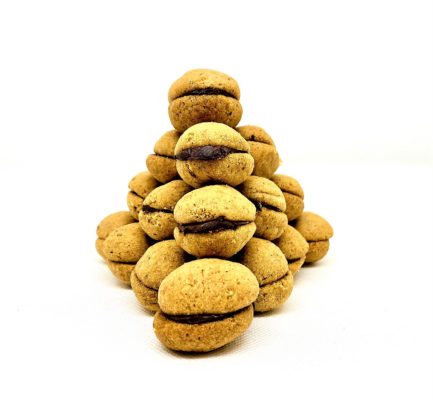
Baci di dama, are probably the most romantic dessert there is, they come in a rounded shape, made up of two half-spheres of Hazelnut Tonda Gentile di Langa IGP cookie, held together, as in a soft kiss, by a mouth-watering layer of chocolate.
The name of the cookie perhaps derives precisely from its shape, the two round halves of hazelnut and flour resembling a maiden’s lips, in the act of giving a kiss.
There are various legends about the birth of this cake, of which the most credited seems to be the one that attributes its paternity to the confectioners of the House of Savoy. The kiss was born in 1852 precisely at the explicit request of Victor Emmanuel II, the king in fact, perhaps fed up with the usual sweets, asked his trusted court cooks to prepare him something new and different from the traditional sweets served at the palace, and that is how this wonderful chocolate cookie was born.
According to other stories and legends, on the other hand, the kiss, always linked to the Piedmontese confectionery tradition, seems to have originated not in Turin, but in Tortona, a town in the province of Alessandria, where, however, it was originally made with almonds instead of hazelnuts.
Baci di Dama: a romantic dessert
| Cooking time: 12 min | Costo: Medium-high |
| Total time: 3 h 30 min | Portions: 40 Baci di Dama |
Ingredients for 40 Baci di dama
- 150 gr roasted hazelnuts (or almonds)
- 150 gr butter
- 150 gr icing sugar
- 1 egg
- 250 gr flour 00
- 1 pinch of salt
- 120 gr dark chocolate for filling
PREPARATION:
The first step in preparing baci di dama is to make the shortcrust pastry. In a fairly large bowl, pour the cubed butter and some sugar. Cook for a few seconds on low temperature and then add the toasted hazelnut flour and run the planetary mixer again. Place the egg whites of the eggs in a bowl and add a pinch of salt.
Next, pour everything into the dough trying to mix well, add some more of the already sifted 00 flour. Mix trying to clean up the edges with a spatula. When the flour is completely absorbed transfer all the dough to a lightly floured work surface so that it does not stick and on top add a drop more flour.
At this point form a ball with the dough and place it in the refrigerator for about two and a half hours wrapped in a layer of plastic wrap.
When the time is up, remove the dough from the refrigerator and the plastic wrap and transfer it back to the floured work surface. Roll out the dough with a rolling pin, trying to get an even thickness of about 1 cm. After that, make 2-cm-long strips of dough using a knife.
Then cut the dough in the other direction as well to make a lattice with strips two centimeters wide to make dough cubes that will have a weight of about 5 grams. Using your hands try to make these cubes into a ball and place them on a baking sheet that will then be placed in the oven.
Bake in a preheated oven for about twelve minutes with a constant temperature of 180 degrees. When the color of the cookies is golden you can remove them from the oven and let them rest for a few minutes so that they warm up.
Now you can move on to the preparation of the chocolate, you need to temper the chocolate before placing it on the half spheres that you created earlier. After that using a cone of baking paper, put on the half of the spheres the chocolate and with the other half close them by pressing them lightly.
Repeat the same operation for all the baci di dama and if the weather is summer to make them solidify well before enjoying them it is advisable to put them in the refrigerator.
8. KRUMIRI:

Source of the photo: ricetteBimby
Krumiri are typical and tasty cookies in the culinary tradition of Piedmont. They are particularly linked to the town of Casale Monferrato, a municipality in the Province of Alessandria; because some accounts report their creation/discovery in the late 1800s in that area. Since then the recipe has never been changed and is even protected by a patent.
They are immediately recognizable due to their special shape and buttery aftertaste that makes it very tasty.
As we previously mentioned its origins date back to 1878 in Casale Monferrato. Legend has it that on a night of that year a pastry chef (Domenico Rossi), in order to thank his co-workers for their work invited them to his home and prepared these cookies with an elongated, narrow shape and a curvature.
In the following years, these cookies were revived and were immediately a huge success, this is evidenced by the countless awards won by this product in the following years (bronze medal at the Universal Exposition in Turin, in 1884, and the Grand Diploma of Honor from King Umberto I).
In addition, the classic curvature that distinguishes it is said to have been dedicated to King Umberto I’s mustache. If the krumiro recipe, patented and always the same since 1878, is jealously guarded by the Portinari family.
The ingredients to make this product, like the recipe are always the same: fresh eggs, butter, wheat flour, sugar and vanillin.
The rest is done by the craftsmanship of those who work and knead every day, respecting the methods and times imposed by tradition.
For example, when making krumiri, the eggs are still broken by hand one by one to best maintain the integrity of the yolk. The eggs themselves and the butter are the only elements added to the flour. Unlike most doughs, there is no water added-this is the decisive aspect that gives it an unmistakable aroma and crispness to the touch!
Krumiri: the cookies in the shape of a “mustache”
| Cooking time: 15 min | Costo: Low |
| Total time: 45 min | Portions: 50 Krumiri |
Ingredients:
- Flour 0 350 g
- Icing sugar 100 g
- Egg yolks3
- Salt up q.b.
- Butter 200 g
- Vanilla pod 1
PREPARATION:
The first step in preparing classic Krumiri is to heat the oven by setting a temperature of 200°. After that, in a container you can start sifting the wheat flour by combining granulated sugar, vanilla and a pinch of salt.
At this point, mix all the ingredients with a kitchen whisk.
Next, separate the egg whites from the yolks and place them in different containers. The egg whites place them in a saucepan on low heat with some butter. After a few minutes, add the yolks to the melted butter as well.
While doing so, start kneading with your hands until you get a smooth and well-blended mixture, you need to leave it to rest wrapped in plastic wrap for about half an hour.
At this point, when the dough has been left to rest for half an hour, fill a pastry bag with the dough and place a star-shaped nozzle so that the krumiro gets its traditional shape. Create cookies with a length of about 7-8 centimeters and slowly insert all the dough into the sac a poche until you run out.
Finally, bake all the krumiri in the oven that had been previously heated for about 15/17 minutes, when this time is over check that the color of the cookies is golden, if they are you can bake them otherwise leave them a few more minutes in the oven.
Before enjoying them, let them cool.
9. LACABONS:

Source of the photo: Alessandra today
Another classic sweet of Alexandria’s culinary tradition are the lacabòn di Santa Lucia, a typical baked product of Alessandria’s patron saint festival.
Lacabons look like small sticks of caramel, are made with honey and sugar, and then are sold wrapped in greaseproof paper for a few euros.
It is very peculiar that the people of Alessandria, on the feast day of Saint Lucy gather in the main church of the city and on its sides, every year, two stalls are placed selling this particular sweet and other treats such as candy or nougat.
One of the historical producers of this sweet was Leonardo Fortino who passed away in early 2000; he learned the traditional recipe from his grandfather and then from his father.
Santa Lucia lacabons are a typical Alessandrian dessert: in fact, you will hardly have heard of them in the rest of Italy!
Santa Lucia is a very heartfelt feast by Alessandrians: for the occasion, the city dresses up for the occasion: here lights, scents, colors, create the atmosphere that has invested the lives of the citizens of Alessandria, from childhood to old age, and continues to do so now for generations, even of the youngest.
A treat to be enjoyed on the street, which adults and children alike love.
“So many Alessandrians have memories of the days of Santa Lucia, spent in this little square from an early age. Because Alessandrians are like that … they seem cold and indifferent even in the face of certain wonders; they often show (or pretend to show) indifference towards important people and in a thousand other similar occurrences but when it comes to traditions it is difficult for them to let them slip by without taking part in them. Saint Lucia is one of these moments.” (quoting Tony Frisina)
Santa Lucia is a place, it is a little church, it is a moment of Alessandrian life.
A coming and going of stories, testimonies, life experiences that continue to live on in the history of this city.
10. THE FOCACCIA NOVESE:
source of the photo: dolciterre
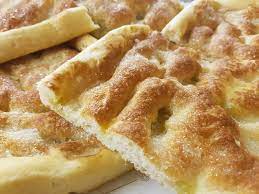
Focaccia Novese is a typical baked product of Piedmontese cuisine (in fact made in Novi Ligure, which despite being misleading is not in Liguria but in Piedmont in the province of Alessandria). It is a type of low focaccia (with a height of about 1 centimeter) seasoned with extra virgin olive oil and coarse salt.
Novese focaccia almost certainly has Genoese origins, and even may date back to the Middle Ages. Beyond the “official” history, focaccia represented a useful tool for bakers to gradually bring the oven to temperature and then devote themselves to baking bread.
Another historical and production feature related to focaccia concerns the use of salt: it is said that Ligurian focaccia was in the past “soaked” with salt water, usually directly with sea water. For the production of Novese focaccia, no such resource was possessed, so initially salt was not used.
The Focaccia Novese: Merger of Piedmont and Liguria.
| Cooking time: 20 min | Cost: Low |
| Total time: 1 h 15 min | Portions: 10 Servings |
Ingredients:
- 1kg flour 00
- 550g water
- 25g yeast
- 50g extra virgin olive oil
- 40g of lard (or even better extra virgin olive oil)
- 20g salt
PREPARATION:
Place the flour in a container or on a work surface, create a small mound with a hole in the center of the and place the yeast, oil (about 40 stalks) and gradually pour in the water.
Next, knead for about 10 minutes, gradually adding the salt.
It is necessary to let the dough rest for about 15 minutes by covering it with a cloth.
With the help of a rolling pin, try to roll out the dough and divide it into four parts and then leave it again on the work surface to rest for about 20 minutes, again covering it with a cloth.
At this point prepare the baking sheet, putting a little oil on it (the traditional recipe does not use baking paper), place the rolled out dough on it and create small alveoli a few inches apart.
Leave the dough still to rest on the baking sheet for another 10 minutes, when the time is up add a little water and salt and brush the entire surface with about 50 grams of oil.
Finally, while the oven is heating to the correct temperature let it rest for another 30 minutes and bake for about 20 minutes with an oven temperature of 230°.
Before enjoying it let it cool for a few minutes and then it is perfect to eat together with typical salami and cheeses from the Alessandria area and a good glass of Piedmontese wine we recommend a nice Nebbiolo d’Alba DOC.
WE JUST HAVE TO CLOSE HERE OUR CULINARY JOURNEY “BTALY ON TOUR” WHERE WE WERE INTRODUCED TO TRADITIONAL ALEXANDRIAN DISHES! IF YOU LIKED IT, YOU JUST HAVE TO COMMENT HERE ON THE BLOG, WE ARE WAITING FOR YOU AND WE GIVE YOU AN APPOINTMENT WITH ANOTHER ARTICLE OF “BTALY ON TOUR”!